

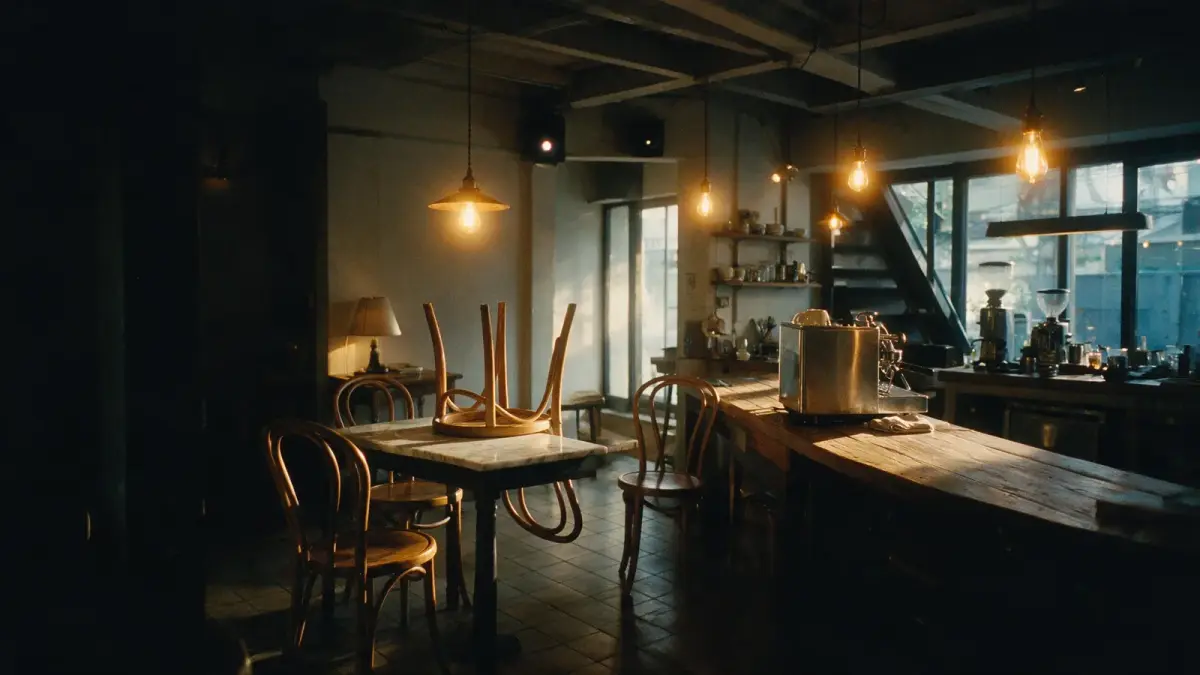
How to Audit the Sound of Your Own Venue
By the finetunes Editorial Team
Short answer: An audit records what your venue sounds like today, before anyone argues about what it should sound like. Five checks: what is actually playing and from where, who has the authority to change it, the volume at three different hours, whether the pace matches each crowd, and whether the sound agrees with your price point. It takes one trading day and a notebook. The output is a written page you can hand to someone, not a feeling. Most operators find the two most expensive faults, no owner and a volume set once at an unrepresentative hour, cost nothing to fix.
Most venues have never written down what they sound like. The music is simply there, the way the lighting is there, arriving from a decision nobody remembers making.
That is a problem the moment you want to change anything. You cannot tell whether a new playlist is an improvement if you have no record of the old one. You cannot brief a supplier on a room you have only described as "a bit tired". And you certainly cannot tell whether the fault is the music at all, or the volume, or the fact that four different people set it on four different mornings.
So before the interesting question, which is what the room should sound like, comes the boring one. What does it sound like now?
What this audit is, and what it is not
An audit is descriptive. It records inputs, not outcomes.
| This audit | Not this audit |
|---|---|
| What is playing, from what source, controlled by whom | Whether the music is raising revenue |
| Volume and pace measured against the actual hour | A taste review of the playlist |
| Whether the sound agrees with the price point | A designed identity for the room |
| A page of written findings | A recommendation |
That last row matters. The temptation is to fix things as you find them, and you will find things. Resist it for one day. An audit that turns into a redesign halfway through stops being a record of anything.
Designing the identity comes after, and it is a separate exercise. The guide to sonic branding covers that side. This piece is only about establishing where you are starting from.
Before you start
You need one normal trading day, a notebook or a note on your phone, and your own ears.
You do not need a decibel meter. Meters give you a number that is honest and useless: 72 dB means one thing in a hard-surfaced room with twenty people talking and something completely different in an empty carpeted one. The tests below use conversation as the instrument, because conversation is what the volume is actually competing with.
Three of the five checks have to happen at different hours, so plan for a first pass at opening, one at your busiest hour, and one late. Total attention required is roughly 90 minutes. It is not 90 consecutive minutes.
One rule: do the audit as a customer would experience it, standing in the room. Not from behind the bar, not from the office, and not from the app on your phone.
Check 1: What is actually playing, and from where
Write down, in this order:
- The source. A commercial music service, a consumer streaming account, the radio, a stored playlist on a device, or a member of staff's phone.
- The account. Whose name is it in? What happens to the music when that person leaves?
- The device. What plays it, where does it sit, and what happens when it loses connection?
- The last change. When did the music last change, who changed it, and why?
Question four is the revealing one. If nobody can answer it, you have found your most expensive fault before you have listened to a single track, and you can skip ahead to check 2 knowing what the report will say.
Note the source honestly. A consumer streaming account in a commercial room brings problems that have nothing to do with taste: advertising breaks aimed at a single listener, a recommendation engine that will follow your morning playlist somewhere it does not belong by mid-afternoon, and a public performance licence question you have to answer separately. Whether a given licence is required, and from whom, depends on where you trade. That is a question for your PRO or a local adviser, not for a blog. But note the source now, because it constrains everything downstream.
Check 2: Volume, at three different hours
This is the check that finds real money, and almost nobody runs it properly, because volume is usually set once at whatever hour the person happened to be standing there.
The one metre test. Stand a metre from another person in the busiest part of the room. Hold an ordinary conversation. If either of you raises your voice, leans in, or repeats yourself, the music is too loud for that hour.
Run it three times:
| When | What you are looking for |
|---|---|
| Opening, or your quietest hour | Music too quiet leaves every conversation exposed and the room feeling flat |
| Your busiest hour | The crowd is now part of the sound. Volume that worked at 9am is usually wrong here |
| Last hour of trade | Energy is dropping and staff are tired. Often the loudest point of the day, set hours ago and forgotten |
Write down the volume setting at each hour, in whatever units your system gives you, even if that is just "notch 4". You are building a record, and a number you can return to is worth more than an adjective.
Volume that is set too high costs you conversation length, and for most venues conversation length and spend are close to the same thing. Volume set too low costs you the room's cover, and every table hears every other table.
Check 3: Pace, against the hour rather than the room
Tempo is the best-evidenced effect in the whole field. Milliman's 1982 supermarket study and his 1986 restaurant study both found that slower music slowed people down: in the restaurant that showed up as a longer stay and a bigger total bill, and in the supermarket as slower traffic through the aisles alongside higher gross sales. The full evidence, and its limits, is set out in the business case for background music.
The practical version is a question you ask three times, once per hour block:
Does the pace of the music match what I need this crowd to do right now?
Then write which way it is wrong, if it is wrong:
- Fast music in a room where you want people to stay and order a second round is costing you the second round.
- Slow music at a lunchtime counter where you need tables to turn is costing you covers.
- The same energy level all day, for three different crowds, is the most common finding of all.
Note that this check has no correct answer in the abstract. It only has an answer relative to your constraint at that hour, which is either turnover or average ticket. Write down which one you are optimising for at each hour before you judge the music. If you cannot name it, that is a finding in itself, and a more important one than the tempo.
Check 4: Fit, against the price point
The congruence research is consistent and slightly uncomfortable. In a restaurant's wine cellar, classical music did not sell more bottles or hold people there longer, it sold more expensive ones. At a supermarket wine display, French music sold French wine and German music sold German, and when customers were asked afterwards, their answers indicated they had not noticed the music affecting their choice.
None of that means "play classical music". It means the room is telling customers what to expect before they read a price, and it is doing that whether you designed it or not.
Stand in the room and ask four questions:
- If a stranger walked in and heard only the music, what would they guess your prices were?
- Is that guess higher or lower than your actual prices?
- Does the music agree with the rest of the room, the lighting, the materials, the menu?
- Would this music make sense in a competitor's venue that sits a tier above or below you?
Question two is the one to write down. Music that sounds cheaper than your prices makes the prices feel high. Music that sounds more precious than your prices makes a casual room feel unwelcoming. Both are congruence failures and both cost, in opposite directions.
Check 5: Continuity
The last check is about what happens over hours and days rather than in a moment.
Repetition. Note any track you hear twice in a shift. Your customers will not notice. Your staff will, because they hear the whole playlist for a whole shift, every shift they work, and they are the reason most venues lose control of the sound: someone gets tired of it and changes it. Repetition is not a taste problem, it is a staffing problem that becomes a governance problem.
Gaps. Note any moment the music stops. A dropped connection, a playlist that reached the end, a device that failed to sync overnight. Unplanned silence breaks a room faster than bad music does, and it almost never gets reported, because the person who notices is a customer and customers do not file tickets.
Variation across days. Ask the question you cannot answer in one shift: does a customer who visits on Tuesday and again on Saturday hear a room with the same character? Consistency is what turns atmosphere into recognition. A venue that sounds different every visit has no sonic identity, however good any single playlist is.
The score sheet
One page. Fill it in as you go and keep it, because the value of an audit is mostly in running it again in six months.
| Check | What you record | Fault if |
|---|---|---|
| 1. Source and control | Source, account holder, device, last change and by whom | Nobody can name who may change the music |
| 2. Volume | Setting at three hours, plus one metre test result at each | The test fails at any hour, especially the busiest |
| 3. Pace | Your constraint at each hour, and whether tempo serves it | One energy level running across different crowds |
| 4. Fit | The price a stranger would guess from the music alone | That guess sits a tier away from your actual prices |
| 5. Continuity | Repeats heard, silences observed, variation across days | Any unplanned silence, or a room with no consistent character |
Five checks, and a venue in reasonable shape usually fails two of them. Failing three or four is common and is not an emergency. It is what happens when a decision gets made once during fit-out and then never revisited.
What to do with the result
Order the faults by what they cost to fix, not by how interesting they are.
- Ownership first, if check 1 failed. One line, written down: who chooses, who may change it, what is never played. Everything else you fix will drift back within a month without this, so it is genuinely first and not merely important.
- Volume second, if check 2 failed. It is free, it takes a shift, and it is the fault most directly connected to how long people stay.
- Pace third, if check 3 failed. Usually this means splitting one all-day setting into two or three, which is a scheduling change rather than a music change.
- Source fourth, if check 1 turned up a consumer account or a member of staff's phone. This one costs money, which is why it sits below the three that do not.
- Fit and identity last. It is the most interesting question on the list and the least urgent. A coherent identity played too loud, through one broken speaker, at the wrong pace, still sounds like nothing.
What this audit will not tell you. It records inputs, not results. Nothing here proves that fixing the volume raised your revenue, because music competes with queue length, staff attentiveness, pricing, weather and whether the coffee is good. It is a real lever with a small handle. Treat the audit as a way to stop making the obvious mistakes, not as a forecast. Measuring whether the sound is working is a separate and harder problem.
Run it again
The single most useful property of an audit is that it is repeatable. Six months from now, the same five checks on the same page will tell you something a one-off assessment never can: whether the fixes held, or whether the room quietly drifted back to whoever opened that morning.
Most of them drift. That is not a failure of the audit. It is what an audit is for.
Most of what an audit finds is fixable in an afternoon by writing something down. The part that is not is keeping a room consistent day after day, legally, without depending on who opened it. That is the part finetunes handles: commercially licensed music built for venues, deep enough to run all day without repeating, with scheduling that changes the pace by the hour instead of by whoever is on shift. Have a look (opens in new window) if your score sheet points that way.
Related Articles
The 12-Hour Music Day: What a Month of Venue Playback Data Says About Thailand
We metered every hour of music our venues played in July 2026, across 38 Thai provinces. The average Bangkok venue ran music for 220 hours. The country peaks at one in the afternoon, not at night. Here is the full shape of the data, and how far to trust each number.
The Business Case for the Music You Play
Music in a venue is an operating lever, not decor. Four decades of field research says it changes how long people stay and what they spend. Here is what the studies found, what they do not support, and how to decide what to change first.

Stop Playing the Hits: Why Music Nobody Recognizes Is Better for Your Business
Every instinct tells you to play songs customers know. The research leans the other way: unfamiliar music can keep people longer, makes your brand memorable, and saves your staff's sanity.