

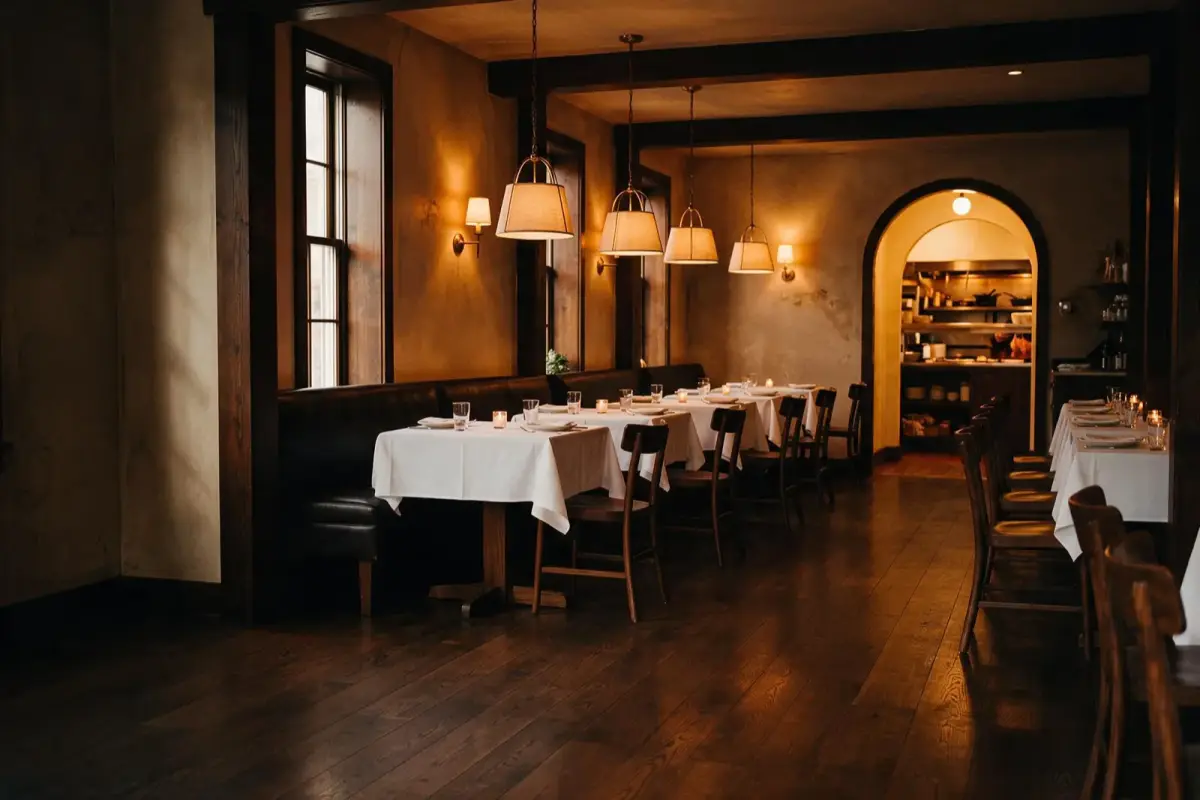
The Business Case for the Music You Play
By the finetunes Editorial Team
Short answer: Background music changes measurable business outcomes, but not in the way most operators assume. The reliable findings are about pace and fit: slower tempo keeps people in the room longer, and music that matches the concept raises what they will pay. Volume and consistency matter more than song choice. The effects are real but modest, they vary by venue type, and most of the headline percentages come from single-site studies decades old. Treat music as one operating lever among several, decide deliberately who controls it, and measure the outcome you actually care about instead of the one that is easiest to count.
Most venues make one music decision, once, and never revisit it. Someone picks a playlist during fit-out, or a shift lead connects a phone, and that becomes the default for years.
It is worth asking what that decision is actually worth. Not in the abstract, but in the same terms you would apply to lighting, staffing levels, or menu design.
The honest answer is that music does less than the marketing claims and more than most operators think.
What the research supports
Field research on in-venue music goes back to 1982. Most of it was run in real shops and restaurants rather than laboratories, which is a point in its favour, though it also means small samples and site-specific conditions.
| Study | Setting | Finding |
|---|---|---|
| Milliman, 1982, Journal of Marketing 46(3) | One US supermarket, nine weeks | Slow tempo (72 BPM or under), fast tempo (94 BPM or over) and a no-music control. Slow music slowed the pace of traffic through the store and raised daily gross sales, $16,740 against $12,112, the 38% that gets quoted everywhere. Worth knowing: neither music condition beat the no-music days by a significant margin. The 38% is slow against fast |
| Milliman, 1986, Journal of Consumer Research 13(2) | Restaurant, Friday and Saturday evenings, commonly reported as 1,392 dining parties | Slow music kept guests at the table longer, 56 minutes against 45, and raised the total bill. The lift came from the bar, $30.47 against $21.62 per group, not the kitchen: food spend showed no significant difference. Slow was compared only with fast, with no silent nights |
| Areni and Kim, 1993, Advances in Consumer Research 20 | A restaurant's wine cellar, 16 Friday and Saturday evenings in 1990, around 11 customers a night | Classical and Top 40 alternating by night: shoppers did not examine, handle or buy more bottles, and did not stay longer, they bought more expensive ones. No silent condition, and the authors call the result consistent but not overwhelmingly supportive: with a correction for testing five outcomes at once it holds at an error rate of 0.15, not the usual 0.05 |
| North, Hargreaves and McKendrick, 1999, Journal of Applied Psychology 84(2) | Supermarket wine display, 2 weeks | French and German music on alternate days. French music sold French wine, 40 bottles to 8; German music sold German, 22 to 12. Questionnaires indicated customers were unaware the music had affected their choice |
| North, Shilcock and Hargreaves, 2003, Environment and Behavior 35 | British restaurant, 18 evenings | Classical music produced higher spend per head than pop music or silence, concentrated in starters, coffee and total food spend |
| Spangenberg, Grohmann and Sprott, 2005, Journal of Business Research 58(11) | Mock store, student participants | Christmas scent with Christmas music improved store evaluations. The same scent against non-Christmas music made them worse |
Two patterns hold across all of it.
Tempo is a pace control. Slow music slows people down. Whether that helps depends entirely on your model. A restaurant selling a long evening wants the extra minutes. A lunchtime counter service turning tables wants the opposite, and slowing customers down actively costs money.
Fit beats quality. None of these studies found that objectively better music performed better. What performed better was music that matched: the concept, the price point, the season, the room. Mismatched music carried a cost even when it was perfectly pleasant on its own.
How far to trust these numbers. Most of the above are single-site field studies from the 1980s and 90s, run in American and British supermarkets and restaurants. The last one is a mock store with 130 students, which is how you get clean data on congruence and also why it is the weakest evidence here. The directions have replicated well. The headline percentages have not. Milliman's 38% is one supermarket, nine weeks, 1982, and it is slow music against fast music rather than against silence. Expect the lever to exist. Do not expect that number in your room.
What the research does not support
This field attracts overclaiming, so it is worth being explicit about the limits.
It does not support a revenue forecast. Nobody can tell you that changing your playlist will raise revenue by a specific percentage. The studies measure effects under controlled conditions in one venue type, usually against a deliberately contrasting alternative. Your baseline is not silence or Top 40 radio, it is whatever you already play.
It does not support genre prescriptions. "Play jazz in a cafe" is not a research finding. The wine studies are often quoted as proof that classical music raises spend, but the mechanism the authors proposed was congruence with an upmarket product category, not classical music having intrinsic value. Classical in the wrong room is as incongruent as anything else.
It says almost nothing about the modern venue. The research predates streaming, playlist algorithms, multi-site scheduling, and the possibility that a member of staff will simply connect their phone. The mechanisms are stable. The operating context is not.
Effects are modest and easily swamped. Music competes with queue length, staff attentiveness, weather, pricing, and whether the coffee is good. It is a real lever with a small handle.
The four jobs music actually does
Setting the studies aside, here is the practical version. Music in a venue does four things, and they pull in different directions.
It sets the pace of the room. This is the best-evidenced effect and the most directly commercial. Faster music moves people through. Slower music keeps them seated and ordering. Which one you want depends on whether your constraint is table turnover or average ticket, and that answer often changes by hour.
It signals price and positioning. Before a customer reads a menu or a price tag, the room has already told them roughly what to expect. Music that sounds cheap discounts a premium space. Music that sounds precious makes a casual space feel unwelcoming. This is the same congruence effect the wine studies found, applied to your whole offer.
It shapes the working day for your staff. Your team hears the playlist for an entire shift, several hundred times a week. Music chosen purely for customers, with no thought for repetition, quietly becomes a staffing problem. It is also the single most common reason venues lose control of their sound: someone gets tired of it and changes it.
It builds or blocks recognition. A customer will not remember your wall colour six months later. They tend to remember how the room felt. Consistency is what turns that into recognition, and inconsistency is what prevents it. A venue that sounds different every visit has no sonic identity, regardless of how good any individual playlist is.
Where operators actually lose money
In practice, the expensive mistakes are rarely about song selection.
Volume set wrong, permanently. Too loud and customers shorten their visit or stop talking. Too quiet and the room feels flat and every conversation carries. Most venues set volume once, at a time of day that is not representative, and never revisit it.
No owner. If nobody is responsible for the music, everyone is. The playlist drifts toward whoever opened that morning. This is the most common failure and the cheapest to fix.
Consumer streaming in a commercial room. Beyond the licensing question, which is a real constraint and worth getting advice on for your own market, consumer services are built for one listener with headphones. They insert advertising, they shuffle toward algorithmic recommendations, and they will happily follow your morning cafe playlist into something that does not belong in the room at 8am.
Silence by accident. A dropped connection, an ended playlist, a device that failed to sync overnight. Unplanned silence breaks a room faster than bad music does, and it usually happens without anyone reporting it.
What to change first
If you are going to make one change, make it the one with an owner attached.
- Decide who controls the music and write it down. Not a policy document, one line: who chooses, who may change it, and what is never played. Everything else depends on this holding.
- Check the volume at three different hours, including the busiest. Two people a metre apart should be able to talk without raising their voices. If they cannot, that is costing you conversation length, which for most venues is the same thing as spend.
- Ask whether the pace is right for the hour, not for the room in general. Most venues run one energy level all day while serving three different crowds.
- Only then think about genre and identity. It is the most interesting question and the least urgent one. A coherent identity played too loud through one broken speaker still sounds like nothing.
Working through those four properly takes one trading day and a notebook. The long version, with the checks written out and a score sheet to keep, is in how to audit the sound of your own venue.
The uncomfortable part
Music is easy to change and hard to attribute. You can rework a playlist this afternoon; proving it moved revenue is a different problem, because so many other things move at the same time.
That asymmetry is why the decision usually gets skipped. It is also why the venues that do treat sound deliberately tend to keep the advantage: the effort is small, the competition is not really trying, and the compounding happens quietly through recognition rather than through anything that shows up cleanly in a weekly report.
The realistic goal is not a measurable revenue lift from a playlist change. It is a room that agrees with itself, every day, without depending on who opened it.
References
Every study referenced above, with a link to the paper itself. Where a figure is "commonly reported", it is a number that circulates in secondary summaries rather than one we have read in the paper, and it is flagged as such in the table. Everything else here comes from the paper or its abstract.
- Milliman, R. E. (1982). Using Background Music to Affect the Behavior of Supermarket Shoppers. Journal of Marketing, 46(3), 86–91. doi:10.1177/002224298204600313
- Milliman, R. E. (1986). The Influence of Background Music on the Behavior of Restaurant Patrons. Journal of Consumer Research, 13(2), 286–289. doi:10.1086/209068
- Areni, C. S., and Kim, D. (1993). The Influence of Background Music on Shopping Behavior: Classical Versus Top-Forty Music in a Wine Store. Advances in Consumer Research, 20, 336–340. full text via the Internet Archive
- North, A. C., Hargreaves, D. J., and McKendrick, J. (1999). The Influence of In-Store Music on Wine Selections. Journal of Applied Psychology, 84(2), 271–276. doi:10.1037/0021-9010.84.2.271
- North, A. C., Shilcock, A., and Hargreaves, D. J. (2003). The Effect of Musical Style on Restaurant Customers' Spending. Environment and Behavior, 35(5), 712–718. doi:10.1177/0013916503254749
- Spangenberg, E. R., Grohmann, B., and Sprott, D. E. (2005). It's Beginning to Smell (and Sound) a Lot Like Christmas: The Interactive Effects of Ambient Scent and Music in a Retail Setting. Journal of Business Research, 58(11), 1583–1589. doi:10.1016/j.jbusres.2004.09.005
Keeping a room consistent, legally and without someone's phone in the loop, is an operational problem rather than a creative one. That is the part finetunes handles: commercially licensed music built for venues, with enough catalogue depth to run all day without repeating. Have a look (opens in new window) if that is the stage you are at.
Related Articles
The 12-Hour Music Day: What a Month of Venue Playback Data Says About Thailand
We metered every hour of music our venues played in July 2026, across 38 Thai provinces. The average Bangkok venue ran music for 220 hours. The country peaks at one in the afternoon, not at night. Here is the full shape of the data, and how far to trust each number.
How to Audit the Sound of Your Own Venue
Before you redesign the sound of a room, write down what it is doing today. Five checks, one shift, a notebook. A sonic identity audit any operator can run without a consultant or a decibel meter.

Subliminal Messages in Music: Myth, Science, and What's Really Influencing You
In 1990, a heavy metal band went on trial for allegedly causing a teenager's death through a hidden message in a song. The verdict changed everything, but the real story of how music influences your mind is far more interesting than any conspiracy.