

The 12-Hour Music Day: What a Month of Venue Playback Data Says About Thailand
By the finetunes Editorial Team
Short answer: In July 2026 the average Bangkok venue on finetunes played music for 220 hours, starting at 07:54 and stopping at 20:06. Venues outside the capital averaged 168 hours. Across the country, playback peaks at one in the afternoon, not in the evening, and weekdays play slightly more music than weekends. Every number in this piece is metered playback from our own player, not a survey. The limits are real and we state them at the end: one month, one season, and venues that already chose a music service, which makes them more engaged than the average shophouse.
Most published numbers about music listening come from surveys. IFPI's global study asks people how many hours they listened last week. Industry forecasts model minutes per user from panels. Useful, but all of it is people describing their own behaviour, which people are famously bad at.
A venue cannot misremember. Our player logs every track it delivers, with a timestamp and a duration, because that is how the product works. So for one month we took the logs from every paying venue we can place by province, across 38 of Thailand's 77 provinces, and asked a plain question: what does the music day of a Thai business actually look like?
This is what came back.
Definitions, so the numbers mean something
- A play point is one music zone inside a venue. A small cafe is one play point. A hotel might run several: lobby, restaurant, spa.
- Hours of music is the summed duration of every track delivered, converted to Thailand time. If a venue plays background music for its whole trading day, that day contributes roughly its opening hours.
- The window is 1 to 31 July 2026, Thailand time.
- Bangkok, Greater Bangkok, upcountry. Greater Bangkok means the five provinces ringing the capital: Nonthaburi, Pathum Thani, Samut Prakan, Samut Sakhon and Nakhon Pathom. Upcountry is everywhere else.
The music day is twelve hours long, and it belongs to the city
| Group | First track (avg) | Last track (avg) | Music per day | Music per month |
|---|---|---|---|---|
| Bangkok | 07:54 | 20:06 | 11.7 hours | 220 hours |
| Upcountry | 08:24 | 18:30 | 9.8 hours | 168 hours |
| Greater Bangkok | 09:48 | 18:12 | 7.8 hours | 125 hours |
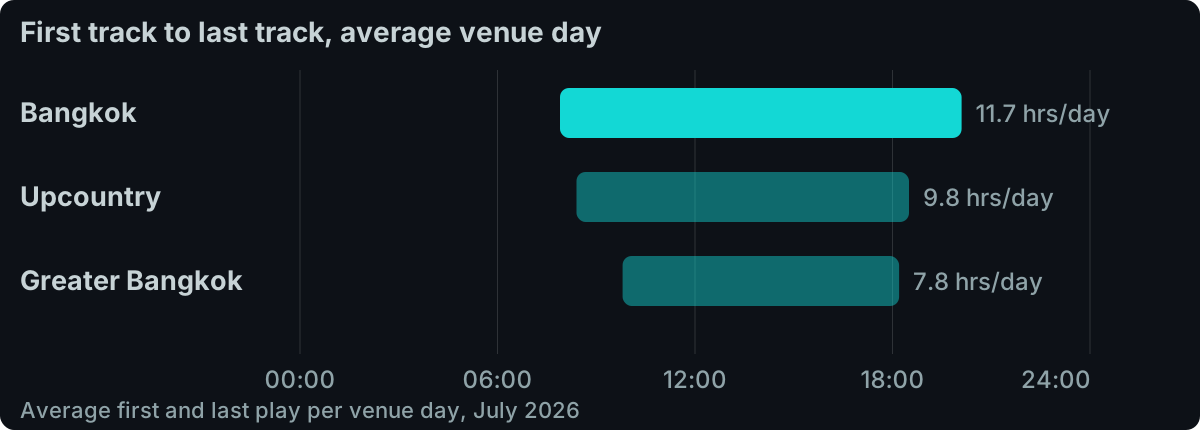
We would have guessed the opposite on at least one of these. The romantic version of provincial Thailand is the cafe that opens before dawn and plays until the last customer leaves. The metered version is that Bangkok venues start earlier, finish later, and play about half again as much music per month as everywhere else.
The Greater Bangkok number surprised us too. The ring provinces run the shortest music day of the three groups, nearly four hours shorter than the capital next door. Our best explanation is venue mix rather than geography, and we say so plainly: a group's average moves with what kinds of businesses happen to be in it.
The country peaks at one in the afternoon
Sum every venue's playback by hour of day and the national curve has a clear shape:
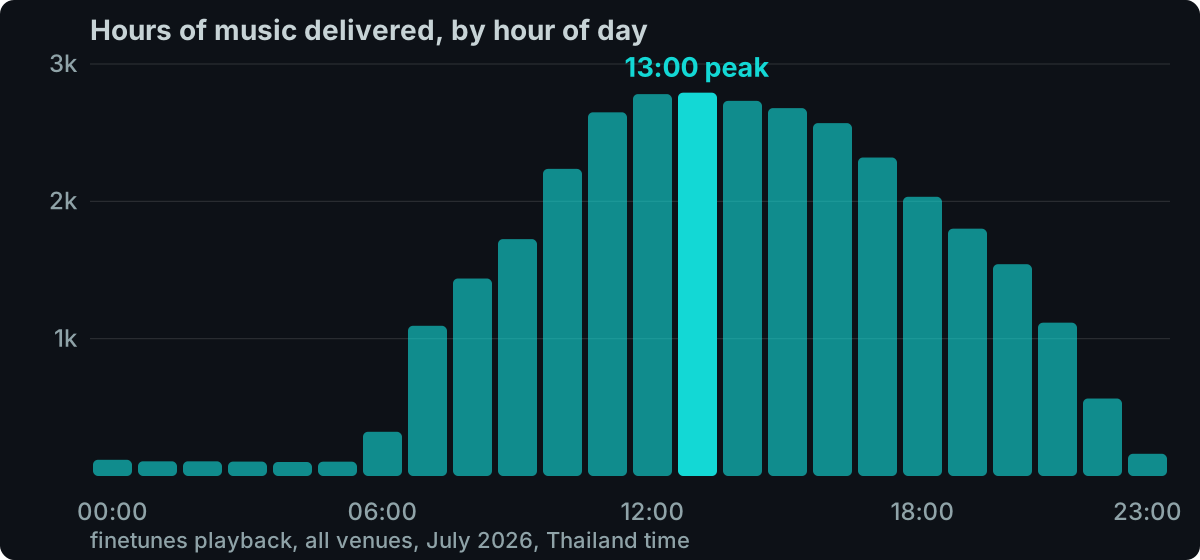
- A quiet floor overnight. Between midnight and 05:00 the whole fleet plays only a trickle of music each hour. Almost all of it comes from a handful of venues that run music around the clock, which we will get to.
- The ramp starts at 06:00 and triples by 07:00. This is the country opening its doors.
- A long plateau from 11:00 to 16:00, peaking at 13:00. The single busiest music hour in Thai venues is lunch, not dinner. The 13:00 slot carries about 26 times the music of a typical overnight hour.
- A slow taper through the evening. Playback at 20:00 is a little over half the lunchtime peak, and by 22:00 the day is effectively over.
If you picture venue music as a nightlife phenomenon, the data disagrees. Thai venue music is a daytime service industry: cafes, restaurants, clinics and gyms soundtracking their working hours. The evening tail exists, but the mass of the day sits between late morning and late afternoon.
Weekends play less, not more, and a trap we nearly fell into
The raw July totals showed Wednesday through Friday playing about thirty percent more music than Saturday and Sunday. That would have been a striking finding. It is also wrong, and the reason is the calendar: July 2026 contains five Wednesdays, five Thursdays and five Fridays, but only four of every other day.
Normalized to hours per single day, the real picture:
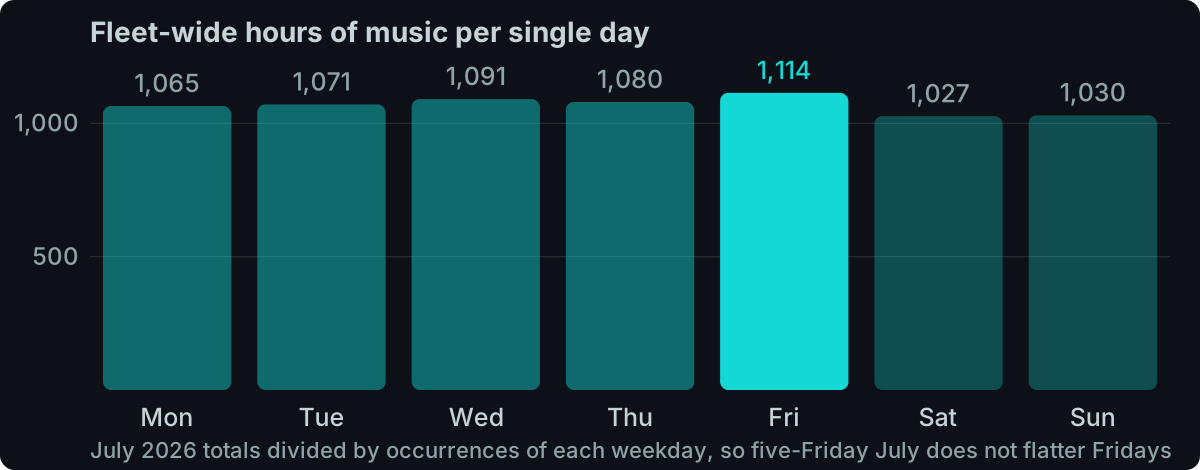
The honest finding is milder and still interesting: weekdays out-play weekends by about five percent, with Friday on top and Saturday at the bottom. Friday against Saturday, the widest gap, is eight percent. For businesses, music tracks the working week, not the social one. We flag the near-miss because a month with five Fridays will flatter any weekday statistic, and we would rather show the correction than publish the artifact.
The exceptions: venues that never turn it off
Averages hide the extremes, and the extremes here are worth meeting. Seven venues across Tak, Ratchaburi and Prachuap Khiri Khan averaged 385 hours of music in July, more than double the Bangkok average. One of them starts its music before four in the morning. Those seven are almost the entire overnight floor in the national curve.
They are also why we did not headline this piece "provincial venues play the most music." Rank provinces by hours per venue and Tak wins comfortably. But Tak's average rests on two venues, and a two-venue province can look spectacular because one busy cafe moves its whole average. The top three provinces in that ranking hold seven venues between them. Seven venues are a story. They are not a region.
How far to trust these numbers. This is one month, in one season, from the venues we can place by province. Upcountry samples are small, and chain venues that bill to a single head office are not in the regional split at all. There is also a selection effect we cannot remove: every venue here already chose a licensed music service, which makes them more deliberate about music than the average Thai business. Treat the shapes as solid, the averages as honest, and the province-level extremes as anecdotes until the samples grow.
What this means if you run a venue
Your music day is probably longer than you think. The average venue in this data runs music for ten to twelve hours a day, 22 days a month. Whatever you play, you play a lot of it. A decision made once at fit-out gets amplified several thousand hours a year.
The high-stakes hours are daytime hours. If the country's venues peak at 13:00, then the playlist that matters most is the one running at lunch, when the room is fullest. Evening ambience gets the attention; midday gets the audience.
Consistency is a weekday job. The weekday lift means background music is part of the working rhythm of Thai business. Music that runs eleven hours a day, five or six days a week, is infrastructure, and it deserves the same seriousness as any other system that runs that long, including being properly licensed for commercial use.
We will rerun these numbers as the fleet grows and the seasons turn. If December looks different from July, that is a finding too, and we will publish it either way.
Every figure in this article comes from finetunes playback logs, July 2026, Thailand time. Nothing here is survey data. Where a comparison rests on a small sample, we have said so in the text.
Update, September 2026
Our players passed three million plays on 29 August 2026. The first million took 274 days from the first play we logged, on 17 September 2025. The second took 40 days and the third took 32. By 18 September the count was above 3.6 million.
- First million17 Sept 2025 – 18 Jun 2026274 days
- Second million18 Jun – 28 Jul 202640 days
- Third million28 Jul – 29 Aug 202632 days
finetunes playback logs, Thailand time, counted on 18 September 2026. Every venue account, paying or not, leaving out our own internal and test accounts.
A play is one track played on one of our players, at any venue account, paying or not. We leave out our own internal and test accounts, and date each play by when it played, Thailand time.
In August 2026, paying venues played an average of 9.6 hours of music a day, counting only the days each venue played music. That is the total hours they played in August, divided by the number of days on which each of them played anything, so a closed day does not pull the average down. A venue here is one play point, as defined at the top of this post, and it counts only on days it had a paid subscription. The same measure for July 2026 is 10.3 hours.
Some players upload plays in batches when they reconnect after time offline, and those plays keep the time they were played. Counts for past dates can therefore still rise a little, which can move the dates above a day or two earlier. We counted these figures on 18 September 2026.
Related Articles
How to Audit the Sound of Your Own Venue
Before you redesign the sound of a room, write down what it is doing today. Five checks, one shift, a notebook. A sonic identity audit any operator can run without a consultant or a decibel meter.
The Business Case for the Music You Play
Music in a venue is an operating lever, not decor. Four decades of field research says it changes how long people stay and what they spend. Here is what the studies found, what they do not support, and how to decide what to change first.

Subliminal Messages in Music: Myth, Science, and What's Really Influencing You
In 1990, a heavy metal band went on trial for allegedly causing a teenager's death through a hidden message in a song. The verdict changed everything, but the real story of how music influences your mind is far more interesting than any conspiracy.