


The Restaurant Soundscape Checklist: From Lunch Rush to Last Table
By the finetunes Editorial Team
Short answer: Start with the six questions below. They take a minute. Any you can't tick shows you where to look, and the full checklist underneath walks you through one day of service. The fixes that matter most, a clear owner and the right volume at the right hour, are usually free.
Every owner knows the feeling of a room that's working: full tables, a hum of conversation, people ordering dessert they didn't plan on. Most of that is the food and the team. Some of it is the sound, and the sound is the part almost nobody checks.
The same room serves a quick lunch and a long dinner, and the music has a say in which one you get. Slower music tends to slow people down, faster music tends to move them along. (The research, and its limits.)
The 60-second check
Tick the ones that are true for your restaurant today.
Ticked all six? Good start. The full checklist is still worth a run once a year. Missed one or more? The section below shows you where to look.
The full checklist
Listen at opening, at your busiest moment of lunch, and again at dinner. Sit at the tables, not behind the bar. For volume, use the one-metre test: talk to someone a metre away at a normal voice. If either of you leans in, it's too loud for that hour.
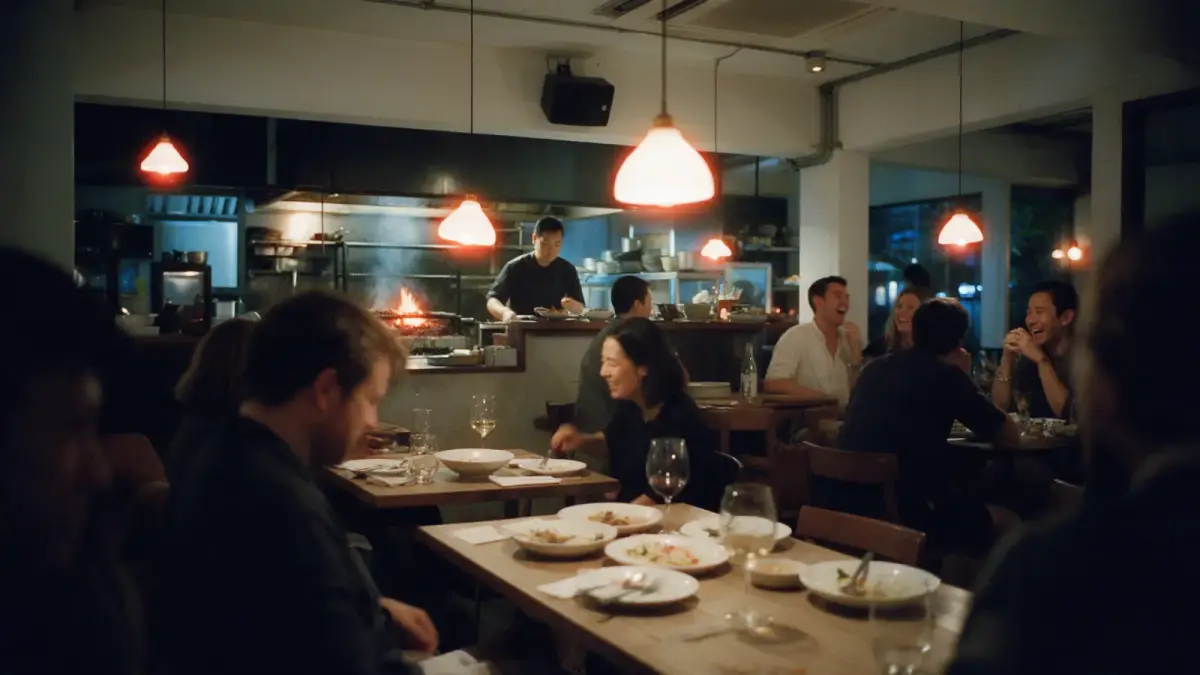
1. First impression
Guests decide what kind of evening it's going to be before they sit down.
Too quiet at 6pm and every early table hears every other early table. An empty room feels emptier for it.
2. Service and time of day
The section that most often changes how an owner thinks about music.
3. Volume
Too loud and conversations get shorter. Too quiet and every table hears every other table.
4. Fit, food and lyrics
Many songs have a lovely melody and lyrics nobody on the team has really listened to, because the language isn't their first. Your guests may hear every word. Filters only catch songs labelled at the source and miss innuendo, so treat the filter as the first check, not the last.
5. Consistency and ownership
Guests are there for an hour or two. Your team hears the playlist all day, and a tired team changes the music. That's usually how a restaurant's sound drifts.
6. Source and licensing
Personal streaming services generally exclude business use in their terms.
Your score sheet
| Section | It's a fault if |
|---|---|
| 1. First impression | The music suggests a bill a tier away from your menu |
| 2. Service and time of day | One setting runs all day, or nobody can say what each service needs |
| 3. Volume | The one-metre test fails at any service |
| 4. Fit, food and lyrics | Lyrics haven't been checked in your guests' languages |
| 5. Consistency and ownership | Nobody owns the music, or a phone runs it |
| 6. Source and licensing | A personal account, or nobody knows who holds the licence |
What to fix first
- Ownership. One line: who picks, who may change it, what is never played.
- Volume. Free, takes a day, and guests feel it at the table.
- Lunch and dinner. Split one all-day setting into two or three.
- Lyrics. One afternoon of listening to the playlist, properly.
- Source. The one that costs money, so it comes after the free fixes.
Want more depth on any check? See How to Audit the Sound of Your Own Venue.
What this won't tell you. A checklist records how your restaurant sounds. It can't prove a change raised your takings, because music sits alongside the food, the service and the weather. Use it to stop the obvious mistakes.
If your sheet points at ownership and time of day, that's the part finetunes handles: licensed music that changes pace on a schedule, so lunch and dinner each sound right without anyone remembering to switch. Have a listen (opens in new window), or if you run several branches, talk to us.
Related Articles

The Retail Store Soundscape Checklist: Does Every Store Sound Like Your Brand?
Six questions you can answer in a minute, then a store-walk checklist from the shopfront to the fitting room to the till. Built for one shop or a whole chain.

The Hotel Soundscape Checklist: Lobby, Spa, Pool and Bar
Six questions you can answer in a minute, then a zone-by-zone checklist for the rest of the day. Find out where your hotel sounds right and where it quietly doesn't.
The 12-Hour Music Day: What a Month of Venue Playback Data Says About Thailand
We metered every hour of music our venues played in July 2026, across 38 Thai provinces. The average Bangkok venue ran music for 220 hours. The country peaks at one in the afternoon, not at night. Here is the full shape of the data, and how far to trust each number.