

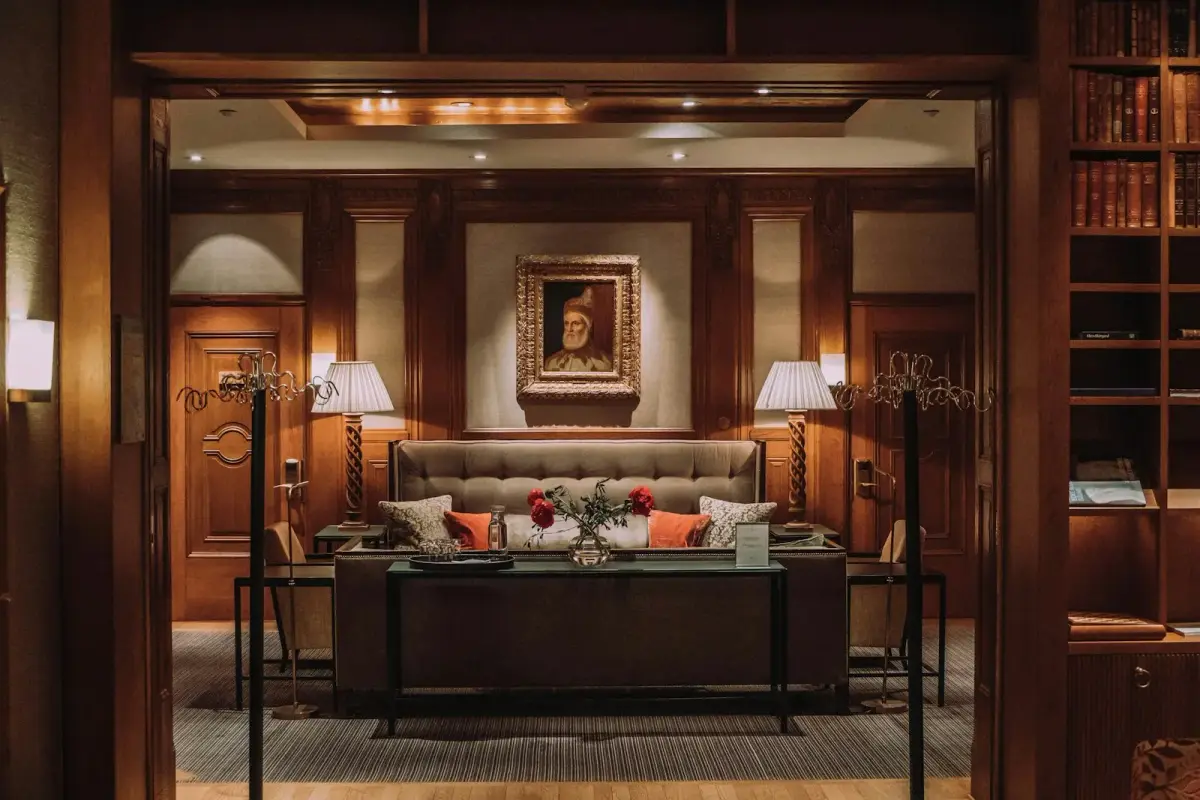
Every Venue Already Has a Sound. Most Didn't Choose It.
By the finetunes Editorial Team
Short answer: Sonic branding for a physical venue is deciding what your space sounds like on purpose, then keeping it consistent, the audio equivalent of interior design. It is not the same thing as an audio logo like Netflix's "ta-dum"; a logo is a three-second sting, a venue is twelve hours of atmosphere. Research going back to 1982 consistently finds that tempo changes how long customers stay, and that music matching the concept raises what they'll pay. The practical work is five steps: define the brand as a person, pick 3–5 mood keywords, build a reference playlist, test it in the actual room, and write a one-page sound guide so it survives your day off.
Every venue with a door has a soundtrack. The only question is whether anyone chose it.
Think about the last place you walked into that felt right. The lighting, the furniture, the materials, all deliberate. And the music wasn't fighting the room; it was finishing it.
Now think about a beautifully built space where something was off. A minimalist café playing Top 40 radio. A quiet bookshop with aggressive electronic beats. A boutique hotel lobby in dead silence at 6pm.
That mismatch isn't a detail. It's the one design decision most venues never actually make, and unlike the furniture, it changes every morning depending on who unlocked the door.
What the Research Actually Found
Most writing on this topic asserts that music matters and moves on. The evidence is more specific than that, and more interesting.
| Study | Setting | What it found |
|---|---|---|
| Milliman, 1982, Journal of Marketing 46(3) | One US supermarket, nine weeks | Comparing slow tempo (≤72 BPM) against fast (≥94 BPM), with a no-music control: slow music slowed the pace of traffic through the store and raised daily gross sales, $16,740 against $12,112, the 38% everyone quotes. Neither music condition beat the silent days by a significant margin, so that 38% is slow against fast |
| Milliman, 1986: Journal of Consumer Research 13(2) | Restaurant, Friday and Saturday evenings, commonly reported as 1,392 dining parties | Slow music kept guests at the table longer, 56 minutes against 45, and raised the total bill. The lift came from the bar, $30.47 against $21.62 per group, not the kitchen, food spend showed no significant difference. Slow against fast only, no silent nights |
| Areni & Kim, 1993: Advances in Consumer Research 20 | A restaurant's wine cellar, 16 Friday and Saturday evenings in 1990, around 11 customers a night | Classical music versus Top 40: shoppers didn't examine, handle or buy more bottles, and didn't stay longer, they bought dearer ones. No silent condition, and the authors call the result consistent but not overwhelmingly supportive |
| North, Hargreaves & McKendrick, 1999, Journal of Applied Psychology 84(2) | Supermarket wine display, 2 weeks | Stereotypically French and German music played on alternate days. French music sold French wine, 40 bottles to 8; German music sold German, 22 to 12. Questionnaire responses indicated customers were unaware the music had affected their choice |
| North, Shilcock & Hargreaves, 2003: Environment and Behavior 35(5) | British restaurant, 18 evenings | Classical music produced higher spend per head than pop music or silence, concentrated in starters, coffee and total food spend |
| Spangenberg, Grohmann & Sprott, 2005, Journal of Business Research 58(11) | Mock store, student participants | Christmas scent paired with Christmas music improved store evaluations; the same scent against non-Christmas music made them worse. Congruence mattered more than either cue alone |
Two patterns hold across all of it.
Tempo is a dial for pace. Slow music slows people down. Whether that helps depends entirely on your business: a fine-dining room wants the extra eleven minutes, a lunchtime counter service does not.
Fit beats quality. None of these studies found that objectively "better" music performed better. What performed better was music that matched: the concept, the price point, the season, the room. Incongruence had a cost even when the music was perfectly pleasant on its own.
How much to trust these numbers. Most of the above are single-site field studies from the 1980s and 90s, run in American and British supermarkets and restaurants. The last one isn't a real shop at all, it's a mock store with 130 students, which is how you get clean congruence data and also why it's the weakest evidence here. The directions have replicated well and are broadly settled. The headline percentages have not: Milliman's 38% is one supermarket, nine weeks, 1982, and it is slow music measured against fast, not against silence. Treat all of this as proof the lever exists, not as a forecast for your room.
Sonic Branding Is Not an Audio Logo
Say "sonic branding" and most people picture a jingle: Intel's five notes, the Netflix "ta-dum," McDonald's whistle. Those are sonic logos: three seconds, attached to a screen, designed to be recognised once and remembered forever.
That is a different job from yours.
For a venue: café, hotel, restaurant, shop, gym, clinic, sonic branding means the deliberate design of what the room sounds like for the whole time someone is in it. Not a sting. A shift.
Think of it as the audio equivalent of interior design.
You wouldn't furnish a restaurant by having each shift manager bring chairs from home. That is functionally what happens when music is handed to whoever's working, or to a streaming algorithm optimising for engagement rather than for your brand.
A useful test: if a regular closed their eyes in your space and heard only the music, would they know whose room they were in? If not, your sound isn't part of your brand yet, it's just filling the air.
The Sameness Problem
Walk any busy street in Bangkok, Melbourne, or Brooklyn and step into five cafés. Three will be playing some variation of the same lo-fi beats, acoustic covers, or "coffee shop jazz."
These aren't bad playlists. They're the audio equivalent of stock photography: functional, forgettable, interchangeable.
The problem isn't the genre. It's that nobody chose it. When every café searches "cafe music" and presses play, every café sounds the same, and none of them sound like anywhere in particular.
Which matters, because sound attaches to memory more stubbornly than décor does. A customer won't recall your wall colour six months on. The feeling of being in your room, partly built out of what they heard, is what survives.
Translating a Look Into a Sound
Interior designers work from a concept: "Scandinavian warmth," "industrial meets botanical," "Japanese minimalism with local character." That concept drives every material and lighting decision.
Audio identity works the same way, from the same brand character.
| Design Direction | Visual Character | Audio Character |
|---|---|---|
| Modern Minimal | Clean lines, neutral tones, open space | Ambient electronic, sparse arrangements, space between notes |
| Vintage / Retro | Warm materials, aged textures, nostalgia | Jazz, soul, analog warmth, vinyl-era recordings |
| Japanese / Zen | Natural materials, simplicity, stillness | Acoustic guitar, piano, nature textures, silence as an element |
| Industrial | Raw surfaces, exposed structures, edge | Indie rock, alternative, textured electronic |
| Tropical / Resort | Natural elements, breezy, relaxed | Bossa nova, reggae, tropical house, world music |
| Luxury / Premium | Rich materials, refined details | Classical, jazz trio, curated lounge |
| Energetic / Vibrant | Bold colours, dynamic layouts | Upbeat pop, funk, dance, high-energy mixes |
One caveat that matters more than the table: two venues in the same design direction should not necessarily sound alike. Two "industrial" restaurants might be rough and rebellious, or refined and intellectual. Their soundtracks should say which.
The table is a starting point. Your position within a direction is where this gets interesting.
A Ten-Minute Fit Check
Before building anything, find out what you currently have. Stand in your own doorway during a normal trading hour and work down this list.
| Check | What you're listening for | Fails if |
|---|---|---|
| The doorway test | What a first-time customer hears in their first five seconds | You can't hear it at all, or it's the first thing you notice |
| The conversation test | Two people a metre apart, talking normally | Either has to raise their voice, or the music vanishes under the air conditioning |
| The concept test | Does this sound like it belongs to this menu, at these prices? | You could swap it into a competitor's room and nobody would notice |
| The corner test | Walk to the furthest seat, then the bathroom | The music dies in one zone and dominates another |
| The shift test | Ask what played yesterday, and the day before | Nobody knows, or the answer depends on who opened |
Any fail is worth fixing before you touch playlists, a coherent identity played at the wrong volume through one working speaker still sounds like nothing.
This is a spot check, not an audit. A full pass, logging what plays hour by hour and scoring it against what you sell, is a longer job, and its own subject.
A 5-Step Framework for Building Your Sonic Identity
You don't need a consultant or a music degree. You need to know your brand well enough to choose on purpose.
Step 1: Describe Your Brand as a Person
Borrowed from brand strategy, and unreasonably effective for sound.
If your business were a person, not your customer, the brand itself, who are they? How old? How do they dress? Where do they spend a Saturday? Calm and considered, or spontaneous? What's playing at their house?
A specialty roaster might be: a 30-something creative who wears simple well-made clothes, spends weekends at flea markets, and works to Khruangbin and Bonobo.
A neighbourhood Italian place might be: a generous host in their 50s who values conversation over table turns, keeps things warm and unpretentious, and always has Chet Baker on in the kitchen.
That persona becomes the compass. Every future decision gets one test: would this person play this?
Step 2: Define 3–5 Mood Keywords
Distil the persona into a few words describing the feeling the room should produce.
- Specialty café: calm, creative, warm, unhurried
- Boutique hotel: intimate, layered, distinctive, serene
- Fitness studio: driven, powerful, electric, bold
- Modern restaurant: confident, contemporary, rooted, refined
This is your brief: the same way you'd tell a designer you want the space to feel warm, unhurried, creative.
Step 3: Build a Reference Playlist
Using the keywords as a filter, curate 20–30 tracks that sound like you.
- Choose from the brand's perspective, not your own taste. You might love death metal. Your brand might be a softly-lit wine bar.
- Think in textures, not genres. "Warm acoustic with subtle percussion" is more useful than "folk."
- Return to the persona every time. Would they have this?
This isn't the in-store playlist. It's the benchmark you measure future choices against.
Step 4: Test in the Actual Room
Music behaves differently in different rooms. Acoustics, crowd noise, ceiling height and foot traffic all change how a track lands. What's perfect on headphones can collapse off hard walls.
Re-run the fit check above with the new material, and add:
- Daypart energy. Morning and evening crowds carry different energy. Character stays constant; intensity moves, like dimming lights without changing the fixtures.
- Staff endurance. Your team hears this all day. Music that irritates on the fortieth pass won't survive the month, whatever it does for customers.
Step 5: Write a One-Page Sound Guide
Document it so it outlives your attention. One page:
- Brand mood, the 3–5 keywords
- Sound direction: genres, subgenres, reference artists
- Boundaries: what never plays: explicit lyrics, clashing genres, tempo extremes
- Volume, tied to the conversation test
- Daypart shifts, how energy moves morning to evening
- Reference playlist, the benchmark
This is the part that keeps the identity alive when you're not in the building. Without it, the sound drifts back to whatever the opening shift feels like, or whatever an algorithm serves next.
The framework at a glance:
- Describe your brand as a person
- Define 3–5 mood keywords
- Build a reference playlist
- Test in the actual room
- Write a one-page sound guide
Five Ways It Quietly Erodes
Playing what you personally love. Your taste belongs in your car. A spa owner who lives for punk still needs calm in the treatment room.
Chasing trends without a filter. A viral track buys a moment of recognition. If it doesn't fit, it reads like a meme poster in a fine-dining room. Trends expire; identity compounds.
Drift across shifts. If Monday morning is a jazz lounge and Tuesday afternoon is a nightclub, nobody can form a memory of your sound. Recognition is the point.
The 20-song death loop. A short playlist left unrefreshed drains a room. Staff hear every track three times a shift and regulars notice. Depth is what lets you rotate without losing direction.
Unplanned silence. Bluetooth drops, playlists end, systems glitch. Sudden dead air breaks the atmosphere faster than bad music does. Plan the fallback.
The One Decision Most Venues Skip
Venues invest real effort in visual identity: logo, interior, packaging, the social feed. All deliberate. Then the audio gets handed to an algorithm or a staff phone.
The rooms that stay in memory tend to be the ones where sound and space read as one thing. Not because the music was objectively better, but because it meant something. It agreed with everything else.
Which is the whole trick. Sonic branding isn't finding a perfect playlist. It's knowing what your brand sounds like, then defending that against forty small daily decisions that would erode it.
Start with the ten-minute fit check. Most venues fail at least two lines of it, and both are fixable this week.
Once you know what your venue should sound like, the operational problem is keeping it that way: consistently, legally, and without someone's phone in the loop. That's the part finetunes handles: commercially licensed music built for venues, with enough catalogue depth to rotate without drifting. Have a look (opens in new window) if that's the stage you're at.
References
Every study in the table above, with a link to the paper itself. Where a figure is "commonly reported", it circulates in secondary summaries rather than coming from the paper, and it is flagged as such in the table. Everything else comes from the paper or its abstract.
- Milliman, R. E. (1982). Using Background Music to Affect the Behavior of Supermarket Shoppers. Journal of Marketing, 46(3), 86–91. doi:10.1177/002224298204600313
- Milliman, R. E. (1986). The Influence of Background Music on the Behavior of Restaurant Patrons. Journal of Consumer Research, 13(2), 286–289. doi:10.1086/209068
- Areni, C. S., and Kim, D. (1993). The Influence of Background Music on Shopping Behavior: Classical Versus Top-Forty Music in a Wine Store. Advances in Consumer Research, 20, 336–340. full text via the Internet Archive
- North, A. C., Hargreaves, D. J., and McKendrick, J. (1999). The Influence of In-Store Music on Wine Selections. Journal of Applied Psychology, 84(2), 271–276. doi:10.1037/0021-9010.84.2.271
- North, A. C., Shilcock, A., and Hargreaves, D. J. (2003). The Effect of Musical Style on Restaurant Customers' Spending. Environment and Behavior, 35(5), 712–718. doi:10.1177/0013916503254749
- Spangenberg, E. R., Grohmann, B., and Sprott, D. E. (2005). It's Beginning to Smell (and Sound) a Lot Like Christmas: The Interactive Effects of Ambient Scent and Music in a Retail Setting. Journal of Business Research, 58(11), 1583–1589. doi:10.1016/j.jbusres.2004.09.005
Related Articles
How to Audit the Sound of Your Own Venue
Before you redesign the sound of a room, write down what it is doing today. Five checks, one shift, a notebook. A sonic identity audit any operator can run without a consultant or a decibel meter.
Stop Playing the Hits: Why Music Nobody Recognizes Is Better for Your Business
Every instinct tells you to play songs customers know. The research leans the other way: unfamiliar music can keep people longer, makes your brand memorable, and saves your staff's sanity.
The 12-Hour Music Day: What a Month of Venue Playback Data Says About Thailand
We metered every hour of music our venues played in July 2026, across 38 Thai provinces. The average Bangkok venue ran music for 220 hours. The country peaks at one in the afternoon, not at night. Here is the full shape of the data, and how far to trust each number.